
Ultimate Guide to Beginner Surf Strength Training
What you need: A surf-specific strength program. Focus on building upper body endurance, a strong core for stability, and lower body strength for explosive movements and impact absorption. This guide breaks down key exercises, explains their benefits, and includes a 4-week training plan to get you surf-ready.
Key takeaways:
- Upper body focus: Pull-ups, rows, and push-ups for paddling power.
- Lower body strength: Squats, lunges, and single-leg exercises for control and balance.
- Core work: Planks, bird dogs, and supermans for stability on your board.
- Injury prevention: Strengthen shoulders, knees, and back to avoid common surfing injuries.
- 4-week plan: Gradual progression to improve strength and endurance.
20 Minute Bodyweight Surf Workout (Follow Along) - Full body
Why Beginner Surfers Need Strength Training
Strength training is a game-changer for beginner surfers, helping your body adapt to surfing's unique physical demands. Since 50% to 65% of your time in the water is spent paddling [7], your muscles need to be ready to handle the repetitive workload without wearing out.
But it’s not just about lasting longer. Tailored exercises can protect your joints, fix muscle imbalances caused by constant paddling, and improve the stability you need to stay in control when the waves get unpredictable. As Michelle Drielsma, a surf fitness expert, explains:
"The effectiveness of your paddling technique directly impacts the number of waves you catch, your endurance in the water, and your long-term participation in the sport" [8].
This foundational strength sets the stage for the specific benefits outlined below.
Better Balance and Stability
A strong core is essential for every surf move - it stabilizes your pop-up and keeps you steady as you ride [4]. Balance depends on stabilizer muscles around your joints, which help you absorb impacts and adjust as your board shifts beneath you [1]. Your legs also play a crucial role, with strong quads, hamstrings, and glutes supporting your hips and knees during turns and landings [3].
Beginners often develop uneven strength, like favoring one leg over the other. Unilateral exercises - think Bulgarian split squats or single-leg deadlifts - help even things out, ensuring a stable stance [1][3]. Practicing balance on tools like an Indo Board for just 5 minutes, three times a week can mimic the instability of a surfboard, sharpening your reaction times [4].
Building Paddling Endurance
If you want to paddle longer without burning out, muscular endurance is key. Upper body strength delivers the power for quick bursts to catch waves, but endurance keeps you going through the hundreds of strokes in a typical session [1].
Paddling also demands that you hold an extended, arched position for long stretches, which puts stress on your posterior chain - the erector spinae, glutes, and upper back muscles [8][5]. Without strength in these areas, you’re likely to deal with lower back pain or fatigue that cuts your session short.
To balance your body and avoid shoulder burnout, surf-specific training focuses on the "pulling" muscles - lats, rhomboids, and posterior deltoids [2][3]. According to the American College of Sports Medicine, using weights at 40% to 60% of your one-rep max with rest periods under 90 seconds is ideal for building endurance [2].
Next, let’s look at how strength training can help prevent common surf injuries.
Preventing Common Surfing Injuries
Surfing takes a toll on your spine, shoulders, and neck, with injuries often caused by repetitive strain and muscle imbalances - not just wipeouts [2].
Shoulder injuries are particularly common, as paddling overdevelops your internal rotators and chest muscles, leading to imbalances that can cause impingement or rotator cuff problems [2][3][5]. Muscle imbalances also increase the risk of shoulder dislocations [2]. Strengthening your rotator cuff and upper back muscles can stabilize the joint and reduce these risks.
Your knees also face a lot of stress, especially during bottom turns and maneuvers. One of the most frequent lower-body injuries is a torn MCL (medial collateral ligament) [2]. Strengthening muscles like the quads, hamstrings, and glutes helps protect your knees from these types of injuries [2][3].
A weak core leaves your spine vulnerable during dynamic movements, increasing the chance of back spasms or spinal injuries [2][4]. As Renegade Surf Travel puts it:
"Increased mobility allows us to be strong in those hard-to-reach positions... decreasing our chances of getting injured" [1].
For beginners, incorporating resistance training 2 to 3 times per week builds the strength needed to stay safe and injury-free [2].
Key Surf Strength Training Exercises
Building strength is crucial for surfing. The right exercises can prepare your body for paddling, popping up, and maintaining balance on your board. Here's a breakdown of the key moves to target the muscles you rely on most in the water.
Upper Body Exercises
Strengthening your upper body is essential for paddling. Focus on pulling movements that mirror the paddling motion.
- Pull-ups: These are perfect for working your lats, shoulders, and upper back while engaging your core [9]. If pull-ups feel too challenging, start with lat pull-downs or use resistance bands for assistance.
- Single-arm Rows: Great for addressing strength imbalances between your dominant and non-dominant sides [1].
- Bottle Hops: Lie prone and repeatedly lift your arms over a small object to build shoulder endurance [5].
Lower Body Strength
Your lower body powers your stance, turns, and landings. Focus on exercises that enhance both strength and explosiveness.
- Squats and Lunges: These build strength in your quads, hamstrings, and glutes, which are key for stability during maneuvers.
- Bulgarian Split Squats: Ideal for isolating each leg and correcting imbalances [1].
- Squat Jumps: These help develop the explosive power needed for quick pop-ups [11].
- Single-leg Romanian Deadlifts (RDLs): Strengthen your posterior chain and improve balance, which is crucial for maintaining an arched paddling posture [1].
Core Exercises
A strong core ties everything together, providing stability on your board and control on unstable surfaces.
- Planks: Build isometric strength for overall stability.
- Bird Dogs: Activate your lower back, abs, and shoulder stabilizers.
- Supermans: These help maintain the arched position needed for paddling [2] [10].
- Cable Woodchoppers or Pallof Presses: Perfect for building rotational strength, which is essential for cutbacks and other dynamic movements [6].
Exercise Summary Table
| Exercise Category | Specific Exercises | Equipment Needed | Primary Benefit |
|---|---|---|---|
| Upper Body | Pull-ups, Single-arm Rows, Bottle Hops | Pull-up Bar, Dumbbells, Bands | Paddle power and shoulder endurance |
| Lower Body | Squats, Bulgarian Split Squats, Lunges, Single-leg RDLs | Bodyweight or Dumbbells | Stability and explosive power |
| Core | Planks, Bird Dogs, Supermans, Dead Bugs | Bodyweight | Stability and rotational control |
| Explosive | Burpees, Squat Jumps, Push-ups | Bodyweight | Quick pop-ups and wave generation |
Expert Advice
Professional strength coach Alan Bisseker emphasizes the importance of simplicity and progression:
"When it comes to improving physical performance in surfing, keep it simple, focus on what exactly it is you're trying to improve, and meet yourself where you're at" [5].
Start with bodyweight versions of these exercises before adding resistance. The goal is to mimic the physical demands of surfing, not to max out on heavy lifting.
Lower Body Exercises
Before adding weight, make sure you’ve mastered the deep squat with a straight back as your foundation [12]. If reaching full depth feels challenging, try holding a kettlebell or dumbbell at chest level for counterbalance, or use a doorframe for support [14].
Squats are a must-have in any routine. They strengthen your quads, hamstrings, and glutes while helping to stabilize your hips and knees [3][13]. Start with bodyweight squats, focusing on proper alignment - your knees should track over your hips and ankles to prevent unnecessary joint strain [14].
To address imbalances and improve stability, include unilateral exercises like Bulgarian split squats, lunges, and lateral lunges. These moves also target muscles that are essential for quick directional changes [1][13].
Single-leg Romanian deadlifts (RDLs) are another great addition. They isolate the hamstrings, glutes, and lower back - crucial muscles for maintaining stability and supporting dynamic movements, especially in surfing [3][13]. Since the most common lower-body surfing injury is a torn MCL [2], strengthening the muscles around your knees is key for staying injury-free. Once you’ve built controlled strength, you can progress to explosive exercises to sharpen your reaction time on the waves.
"Strong legs are the foundation for good surfing. By incorporating these exercises into your routine, you'll be well on your way to improving your surfing performance, and staying injury-free."
- Surf Strength Coach [13]
For explosive power, try squat and lunge jumps. These exercises help develop the quick-twitch muscle response needed for smooth transitions from paddling to standing. Always focus on landing softly to protect your joints [14]. To build strength, the American College of Sports Medicine suggests doing multiple sets of 6 to 12 reps, with 1 to 2-minute rest periods between sets [2]. Prioritize perfect form before advancing - once you’ve nailed the basics, you can add weight, increase the number of reps, or slow down the lowering phase to boost time under tension [1]. These foundational lower body exercises will set you up for more advanced routines discussed in later sections.
Upper Body and Paddling Drills
To tackle those long paddle-outs, you'll need endurance more than brute strength. Surfers spend a whopping 55% of their time paddling during a session [5], so focusing on upper body stamina is key. Your shoulders, back, and arms must endure the repetitive paddling motion without tiring before you even make it to the lineup.
Start with push-ups - they're a classic for a reason. To make them surf-specific, keep your elbows tucked close to your ribs as you lower yourself. This mimics the paddling stroke and strengthens your triceps [15]. If regular push-ups feel too easy, narrow your hand placement for tricep push-ups to up the challenge.
"You can have the best pop-up in the world, but if you can't paddle out past the break, you aren't going to catch many waves!" - Wavehuggers Surf School [15]
Resistance bands and TRX straps are excellent tools to simulate paddling. For example, with a resistance band anchored in front of you, try the swimmer's pull. Either kneel on a stability ball or squat slightly and mimic alternating paddling strokes [19]. Using TRX straps, you can perform kneeling lat pull-downs: let your body lean forward in a straight line, then pull yourself back to strengthen your pulling muscles [20].
Don't forget to train the muscles that support your paddling. Pull-ups and lat pulldowns are great for building strength in your lats and biceps, which power the pull phase of each stroke [15][17]. Not quite ready for full pull-ups? Assisted pull-ups or lat pulldowns are great starting points [16][17]. Add dumbbell rows and seated cable rows to your routine to target your traps, rhomboids, and rear delts, which protect your shoulders during long paddling sessions [3][17].
To maintain proper form on your board, include Superman holds in your workout. Holding this position for 15–30 seconds strengthens your lower back extensors, helping you keep your chest up while paddling [17]. Tricep dips are another must - these target the back of your arms, which often tire out first during heavy paddle-outs [15][18]. Beginners can aim for 2–3 sets of 15–20 reps with lighter resistance to focus on building endurance rather than raw strength [19].
For the best results, train your upper body 2–3 times a week. Stick to 40%–60% of your one-rep max and keep rest periods under 90 seconds between sets [2]. This approach will help you build the stamina needed to paddle out and catch the waves you’re aiming for.
sbb-itb-de7840d
Core Strength and Balance Workouts
To complement your upper and lower body training, building a strong core is essential for seamless movement on the board.
Your core involves more than just the visible abs - it includes deeper muscles like the transverse abdominis, which play a key role in maintaining balance on the water. Before focusing on explosive power, it's crucial to prioritize stability. This stability protects your spine, keeps it neutral, and ensures your upper and lower body move in sync [21].
"Core stability simply indicates how well you can protect the spine with the muscles in the torso, the ability to keep a neutral spine... and whether you can move your lower body and upper body together in a coordinated fashion." - Nick Holt, CPT [21]
Start with foundational exercises like the Dead Bug - lie on your back, extend opposite arms and legs, and keep your lower back pressed firmly to the ground. Another great option is the Bird Dog, where you extend opposite limbs while maintaining balance, eventually bringing your elbow and knee together in a controlled motion [21]. These moves teach your hips and pelvis to work in harmony, which directly improves your board control [14][21].
Once you've nailed the basics, progress to static exercises such as planks, side planks, advanced RKC planks, and Stir the Pot, which challenge endurance [21]. For rotational strength, try Russian twists or Pallof holds, being mindful to rotate from your upper spine for maximum effectiveness [3][6][24].
To mimic the instability of the ocean, incorporate stability ball exercises. For example, perform stability ball jack-knives by starting in a push-up position with your feet on the ball, then drive your hips upward into a V-shape. Beginners can position the ball under their shins for extra support [23]. Exercises like single-leg deadlifts and ball rotations also engage stabilizing muscles, prepping you for the unpredictability of the waves [14][22].
Aim to train your core 2–3 times per week, focusing on proper form to maximize your board control. These core and balance exercises lay the groundwork for a structured 4-week surf strength program.
4-Week Beginner Surf Strength Program
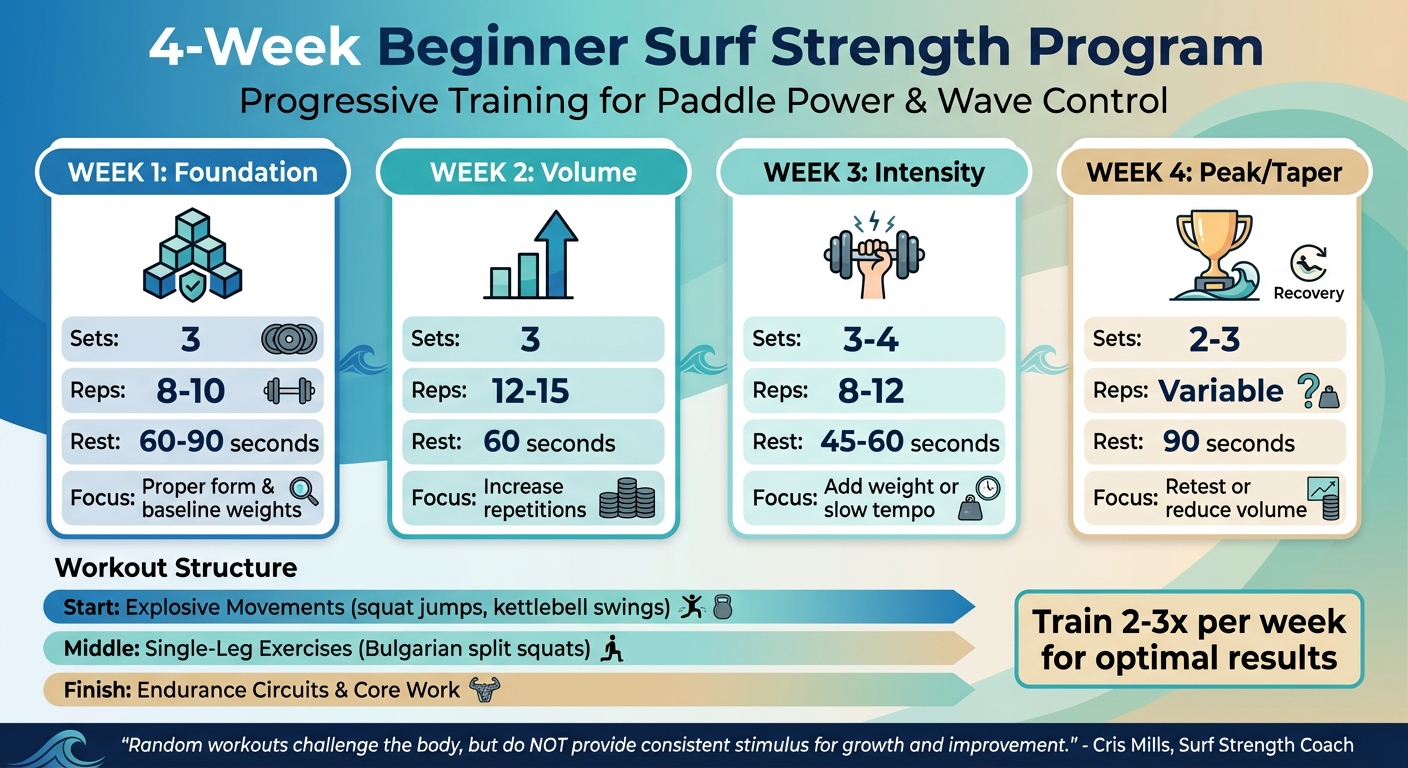
4-Week Beginner Surf Strength Training Program with Weekly Progression
Here’s how to structure a 4-day weekly program to build strength and endurance for surfing. Each session should follow a specific order: start with explosive movements like squat jumps or kettlebell swings, move into single-leg exercises such as Bulgarian split squats, and finish with endurance circuits and core-focused work. This sequence helps you perform better while minimizing the chance of injuries.
"Random workouts will challenge the body, but they do NOT provide a consistent stimulus that your body must adapt to, grow, and improve." - Cris Mills, Surf Strength Coach
The program is designed to gradually increase intensity over four weeks:
- Week 1: Focus on building a strong foundation. Perform 3 sets of 8–10 reps, resting 60–90 seconds between sets.
- Week 2: Increase the number of reps to 12–15 per set, keeping rest periods at 60 seconds.
- Week 3: Challenge yourself by adding weight or slowing your tempo, while reducing rest to 45–60 seconds.
- Week 4: Either retest your baseline lifts to measure progress or reduce the workout volume to allow for recovery.
| Week | Focus | Sets | Reps | Rest Period | Progression |
|---|---|---|---|---|---|
| Week 1 | Baseline & Form | 3 | 8–10 | 60–90 sec | Work on proper form and establish starting weights |
| Week 2 | Volume | 3 | 12–15 | 60 sec | Increase repetitions while maintaining good form |
| Week 3 | Intensity | 3–4 | 8–12 | 45–60 sec | Add weight or slow your tempo to build strength |
| Week 4 | Peak/Taper | 2–3 | Variable | 90 sec | Retest max reps or reduce volume for recovery |
This program fits perfectly into a larger surf-focused fitness routine, helping prepare you for more advanced training and actual time in the water. Don’t have access to a gym? No problem - there are simple home-based alternatives for every exercise. For instance, try Prone Bottle Hops: lie face-down and lift your arms over water bottles to mimic the shoulder burn of paddling.
Next, discover how this strength program can complement your surf camp experience in Bali.
Combining Strength Training with Surf Camps in Bali
Bali offers the perfect setting to combine a 4-week strength training program with real-world surf practice. With water temperatures averaging between 79°F and 86°F, you can focus on refining your technique without the need for a wetsuit [26]. This warm, inviting environment creates an ideal backdrop for blending physical training with time on the waves.
Beginner-Friendly Surf Camps
If you're just starting out, Bali has some excellent surf camps tailored to beginners. Kima Surf Camps, located in prime spots across the island, offer packages designed to build both strength and surfing skills. These include daily guided surf sessions, yoga classes, and video analysis to help you improve. Prices start at around $21 per person per night in Seminyak [26]. With up to 16 guided trips daily, Kima ensures you'll always find waves that match your current fitness and skill level.
Another great option is Padang Padang Surf Camp, which specializes in helping beginners progress quickly. They use big-screen video reviews to pinpoint areas for improvement. In 2021, a beginner named Ian shared how this approach helped him transition from a foam board to a fiberglass board by his fourth lesson:
"Once you see on camera where you are making mistakes it hits home a lot quicker." [28]
At Padang Padang, lessons cost about $47 per day for two sessions [28]. These camps not only focus on skill-building but also emphasize recovery and balanced training to keep you in top form.
Balancing Training and Recovery
To avoid burnout, limit intense strength workouts to three 60-minute sessions per week [1]. Many camps, like those in Bali, incorporate yoga sessions to enhance flexibility, build upper body strength, and aid recovery between surf sessions [25][26].
Start each morning with 5–10 minutes of mobility exercises for your hips and shoulders [1]. For instance, in June 2025, Justin Arana completed a six-week program at Fetch Surf Concept in Bali. This program, which starts at $90, combined technical coaching with physical rehabilitation. By balancing strength training with recovery techniques, Justin lost 13 pounds, regained full shoulder function, and was able to return to surfing after struggling to paddle [27].
Take advantage of recovery tools like ice baths and breathwork sessions offered at many camps. These can help you recharge between morning and afternoon surf outings [1].
For a deeper dive into beginner-friendly camps that integrate strength training, skill development, and recovery, check out the listings on Find Surf Camp Bali.
Conclusion
Strength training tailored for surfing can elevate your performance in the water. By focusing on key areas like your lats, shoulders, and core, you’ll experience less fatigue, quicker pop-ups, and more controlled turns. As professional strength coach Alan Bisseker explains:
"Strength and conditioning (if used correctly) will just allow you to perform faster, harder, and for longer – and who doesn't want that!" [5]
Building upper-body endurance is especially important for catching wave after wave. Committing to training 2–3 times a week [2] can make the difference between cutting your session short and staying out there longer.
The real magic happens when you combine your training with actual time in the water. Bali’s inviting waves provide the perfect setting to put your hard-earned strength to use, especially with expert guidance.
Want to take it further? Check out beginner programs on Find Surf Camp Bali, where you can pair strength training with daily surfing, recovery yoga, and video analysis to refine your skills.
FAQs
How can I effectively combine strength training with surfing practice?
To blend strength training with surfing effectively, aim for a balanced weekly schedule where both activities enhance each other. Plan for 2–3 strength training sessions per week on days you’re not surfing, keeping each workout between 45–60 minutes. Focus on exercises that strengthen the muscles you rely on for surfing, like your lats, shoulders, chest, arms, and core. Start with dynamic warm-ups - think squats with arm movements or banded shoulder rotations - to boost mobility and mimic surf-specific movements. Incorporate compound exercises such as push-ups, rows, and medicine ball slams, and wrap up with light stretching to aid recovery.
On surfing days, treat your time in the water as both a cardio workout and a skill-building session. You can also add short conditioning drills tailored to surfing, such as paddle sprints or beach intervals, to enhance endurance. Avoid heavy lifting on these days to prevent overexertion. If you want to train, stick to light bodyweight exercises and prioritize recovery techniques like foam rolling, staying hydrated, and getting enough rest. A simple routine could include strength training on Monday, Wednesday, and Friday, with surfing or light mobility work on the other days. By syncing your workouts with your surf sessions, you’ll boost paddling strength, improve your pop-up technique, and reduce the risk of injury over time.
What exercises can help prevent common surfing injuries?
To help prevent common surfing injuries like shoulder strain, lower back pain, and knee problems, it’s important to focus on mobility, core stability, and functional strength exercises. Start with mobility drills like ribcage rolls, lunges with a twist, and deep squat progressions. These moves can improve flexibility in your shoulders, spine, and hips, which are key areas for surfers. Adding single-leg balance exercises is also a great way to stabilize your knees.
For building strength, try incorporating planks, push-ups, and pull-ups. These exercises boost core and upper body endurance, which are crucial for paddling and quick pop-ups. To protect your shoulders, include scapular push-ups and resistance band rotations in your routine. For leg strength and proper alignment, front squats are a solid choice. Wrap up your workout with some light stretching for your shoulders, hips, and back to enhance flexibility and ease muscle tension.
If you’re on the road and still want to train, Find Surf Camp Bali offers surf programs that include these injury-prevention exercises. It’s a convenient way for beginners to stay strong and safe while mastering the waves.
How does strength training help beginners paddle longer while surfing?
Strength training targets crucial muscle groups such as the rotator cuff, lats, and upper-back muscles - key players when it comes to paddling. Building strength in these areas improves muscular endurance and stabilizes shoulder mechanics, helping beginners paddle with greater efficiency and for extended periods without tiring as quickly.
By concentrating on these muscles, you’re not just enhancing endurance; you’re also lowering the chances of shoulder strain. This means you can enjoy your surf sessions more while staying injury-free.
Related Blog Posts
Subscribe to receive the latest blog posts to your inbox every week.
