
Ultimate Guide to Surfing Basics
Surfing is more than just riding waves - it's a sport that strengthens your body, sharpens your focus, and provides a mental escape. Here’s a quick rundown of what beginners need to know:
- Health Benefits: Surfing improves strength, balance, endurance, and mental well-being. It’s also great for stress relief and better sleep.
- Beginner Gear: Start with an 8–9 ft foam board ($300 avg.), a leash, surf wax, and a wetsuit suited to water temperature.
- Key Techniques: Learn paddling, the pop-up, and how to catch small whitewater waves. Practice pop-ups on land to build muscle memory.
- Safety & Etiquette: Respect wave priority, avoid dropping in on others, and learn to spot rip currents. Stick to beginner-friendly beach breaks.
- Surf Camps: Accelerate your progress with structured lessons, gear rentals, and expert guidance. Bali is a top destination for beginners.
Whether you’re drawn to the physical challenge or the calming rhythm of the ocean, surfing offers a rewarding journey. Start small, stay consistent, and enjoy the ride.
The Complete Beginners Guide To Surfing
Surfing Equipment for Beginners
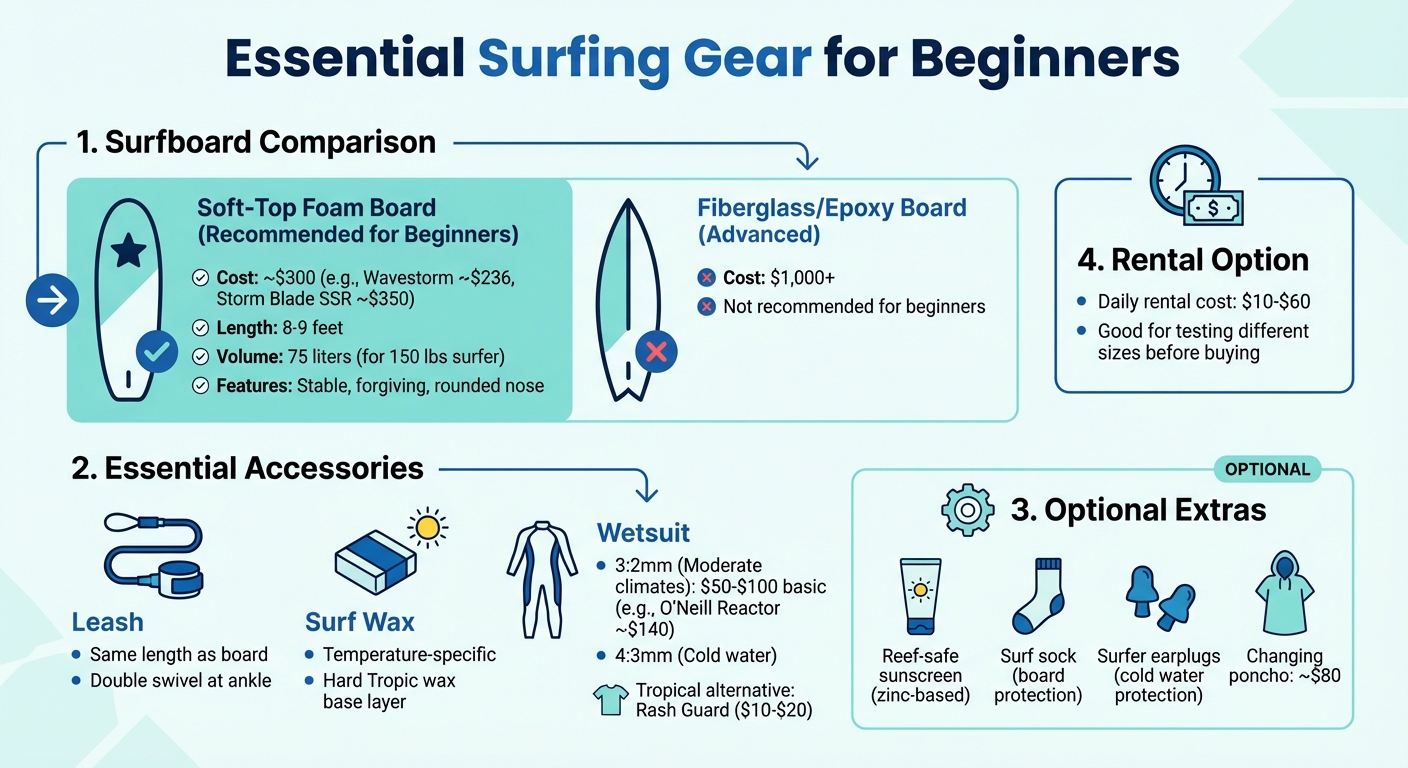
Essential Surfing Gear Guide for Beginners: Equipment Costs and Specifications
Getting the right gear as a beginner is key to improving your skills and staying safe - without breaking the bank. Here’s a guide to picking your first surfboard and the essential accessories you’ll need.
How to Choose Your First Surfboard
For beginners, soft-top foam boards are the go-to option. These boards are not only affordable - typically priced around $300 - but also much easier to handle than pricier fiberglass or epoxy boards, which often cost $1,000 or more[6]. Professional surfer Josh Kerr sums it up perfectly:
"When you first enter the world of surfing, soft-top surfboards are your best allies. These boards... are exceptionally stable and forgiving compared to other types of boards." [8]
Soft-top boards offer stability and are more forgiving, making them ideal for learning. The recommended size for most beginners is between 8 and 9 feet long - usually 12 to 24 inches taller than your height[4][8]. For instance, if you weigh about 150 pounds, look for a board with around 75 liters of volume, using a general 2:1 weight-to-volume ratio[9]. Boards with a rounded nose make paddling easier, while a rounded or squash tail adds stability[6][9]. Popular beginner models include the Wavestorm (approximately $236) and the Storm Blade SSR (around $350)[11].
If you’re unsure about committing to a purchase, renting a board is a smart first step. Rentals typically cost $10 to $60 per day, allowing you to try different sizes. Once you’re in the water, make sure your toes are near the tail of the board. Adjust your position if needed: if the nose sticks up more than 2–3 inches, move forward; if it dips underwater, move back[4][10].
Other Gear You'll Need
A leash is non-negotiable - it keeps your board close and prevents it from drifting away or causing harm to others. Jake Adee, owner of Dawn Patrol Surf School, advises:
"You want the leash to be about the same length as the board, and you want a double swivel at the ankle." [11]
Surf wax is another must-have. It provides grip on the board’s deck, so you don’t slip. Choose a wax suited to your water temperature, and for better traction, apply a hard Tropic wax as a base coat before adding a temperature-specific top layer[11].
For wetsuits, the water temperature determines the thickness you’ll need. A 3:2mm wetsuit works well for moderate climates, like Southern California, with basic models costing $50–$100 or entry-level options like the O'Neill Reactor priced around $140[6][11]. In colder areas, such as Northern California, opt for a 4:3mm suit[11]. If you’re surfing in tropical waters like Hawaii, a wetsuit might not be necessary. Instead, a rash guard - priced between $10 and $20 - can protect your skin from friction burns and harmful UV rays[6].
Adee also highlights a common mistake beginners make:
"The biggest beginner mistake is letting it [a wetsuit] dry in the sun. It's a petroleum-based product, and it degrades in UV - it will stretch, lose the elasticity, and crack." [11]
To complete your setup, consider these extras:
- Reef-safe sunscreen: Zinc-based formulas are best for protecting both your skin and the environment.
- Surf sock: Protects your board during transport.
- Surfer earplugs: Prevents issues from prolonged exposure to cold water.
- Changing poncho: Makes gear changes easier and costs about $80.
With the right equipment, you’ll be ready to hit the waves and enjoy the ride.
Basic Surfing Techniques
With your board and gear ready, the next step is learning the basics of paddling. These skills are the building blocks of surfing, and while they take time to get the hang of, the effort pays off when you’re out on the waves.
How to Paddle Correctly
Lie flat on your stomach with your chest centered on the board. Keep your back slightly arched and your head lifted to see ahead and prevent the board’s nose from dipping into the water. Pro surfer Josh Kerr offers this advice:
"Center your chest on the board. As you paddle, arch your back up slightly and lift your head. This will let you see where you're going and helps the nose out of the water." [12]
Keep your legs together on the board to minimize drag. For each stroke, extend your arm forward, dig your hand deep into the water, and pull back in a smooth, controlled motion. Avoid shallow strokes that splash and waste energy. Ideally, the nose of the board should hover about 2 to 3 inches above the water. If it’s too high, you’ll lose speed by pushing water; too low, and you risk nosediving.
Key paddling tips:
- Legs: Keep them together, not dangling off the board.
- Chest: Stay lifted with a slight arch in your back.
- Strokes: Use deep, steady pulls rather than quick, shallow ones.
- Board Nose: Aim for 2–3 inches above the water.
Adjust your position slightly forward or backward to find the optimal glide. As a wave approaches, start paddling calmly, then pick up speed to match the wave’s momentum for a smooth takeoff. Use your core muscles for power and focus on steady breathing - inhale through your nose and exhale through your mouth - to build endurance for longer sessions.
Once you’ve got paddling down, it’s time to tackle the pop-up.
The Pop-Up and Your Stance
The pop-up is the move that takes you from lying down to standing - and it’s often the toughest hurdle for beginners[4]. Place your hands near your ribs (not the board’s edges) to keep stable. In one quick motion, push yourself up and bring your front foot forward between your hands, followed by your back foot. Avoid using your knees to push up - it slows you down and can lead to bad habits[4][13].
When you’re standing, position your feet shoulder-width apart, centered over the board’s stringer (the middle line). Your feet should be perpendicular to the board’s length. Keep your knees bent slightly inward to lower your center of gravity, and stay upright with your eyes on the horizon. Looking down at your feet or the board can throw off your balance[3][7]. Hayley Gordon, founder of SurfingHandbook.com, explains:
"Surfing is not too hard once you're on your feet, but getting to your feet and staying there is 90% of the battle." [4]
Practicing 20 pop-ups daily on dry land helps build muscle memory before you try it in the water[4]. To control your speed, shift your weight forward to accelerate or to your back foot to slow down[7].
How to Catch Your First Waves
Start with the whitewash - the foamy, broken waves near the shore. These are more forgiving than unbroken “green” waves[14][7][10]. Position yourself so the nose of your board is about an inch above the water. As the wave approaches, paddle hard toward the shore using the same deep, steady strokes you practiced earlier. The goal is to match the wave’s speed so it lifts you instead of passing underneath.
Once the wave picks up your board, pop up right away. Most beginners can stand and ride after catching about 30 to 50 small waves or whitewash rollers[2]. If you fall, protect your head with your arms and stay underwater for a few seconds to avoid the board hitting you when you resurface[6].
Longboards are too buoyant for duck diving, so use the turtle roll to handle oncoming waves. Flip the board over and hold on underneath while the wave passes above[6][10]. As you improve, try angling slightly toward the wave’s shoulder instead of heading straight to shore. This technique makes it easier to get onto the face of green waves[13][6].
sbb-itb-de7840d
Safety Rules and Surf Etiquette
Once you've got the basics down, it's time to focus on safety and respect in the lineup. Surfing isn't just about catching waves - it's also about sharing the water responsibly. By following a few key rules, you can help create a safer and more enjoyable experience for everyone.
Basic Rules of Surf Etiquette
The number one rule? Right of way. The surfer closest to the peak of the wave has the priority. As Janna Irons of Outside Online explains:
"The person who is closest to where the wave breaks (also known as 'deeper') has the right of way."
Never "drop in" on someone already riding a wave - it’s not only rude but can also lead to accidents. Similarly, avoid "snaking" or "back-paddling", which means paddling around another surfer to take their spot closer to the peak. These behaviors disrupt the flow of the lineup and can create tension.
Always maintain control of your board. Letting it go or throwing it when a wave hits can put others at risk. If you accidentally drop in on someone, own up to it and apologize right away. For beginners, it's a good idea to stick to the edges of the main peak or practice in the whitewater section to avoid getting in the way of more experienced surfers.
Once you've got the etiquette down, shift your attention to staying safe in the water.
How to Stay Safe While Surfing
Before you paddle out, spend at least 30 minutes observing the beach. Look for wave patterns, rip currents, and any potential hazards like rocks. Equip yourself with a leash that matches the length of your surfboard - this keeps your board secure and reduces the risk of it hitting others.
Rip currents, which are channels of water flowing back out to sea, are a common hazard. They often appear as darker areas with fewer breaking waves. If you get caught in one, stay calm and hold onto your board. As Star Surf Camps advises:
"The most important thing to do in a rip is to remain calm. If you have a bodyboard or surfboard do NOT let go!"
When paddling back out to the lineup, avoid crossing paths with surfers riding waves. Instead, paddle toward the whitewater, the broken part of the wave, rather than the clean face where someone is riding. Independent Surfer puts it simply:
"When in doubt, always paddle towards the white water."
If you fall, try to land flat to minimize the risk of injury from the seabed. When resurfacing, use your arms to protect your head from your board. Beginners should stick to beach breaks, which are generally safer and more forgiving than reef breaks, which demand more skill and experience.
Learning at Surf Camps
If you're serious about improving your surfing skills, surf camps are an excellent way to speed up your progress. While self-taught surfers might need weeks - or even a month - to consistently stand on their boards, surf camps can dramatically shorten that learning curve. In fact, many beginners go from mastering the basics to riding the face of a wave in just one week [15][16].
Why Choose a Surf Camp?
The advantage of surf camps lies in their structured approach. Certified instructors provide personalized feedback and real-time corrections, helping you avoid bad habits before they take root. As SURFER Magazine puts it:
"Taking lessons from certified instructors can help you develop proper technique and good habits." [3]
With professional guidance, many first-timers are able to stand up on their boards during their very first lesson [5]. Beyond just standing, instructors teach you how to read waves - a skill that can take months to figure out on your own. You'll learn to spot wave patterns, understand tides, and predict where waves will break, which are critical skills for any surfer [5][15].
Safety and etiquette are another key focus at surf camps. You'll get a solid understanding of the Surfer's Code, learn how to navigate crowded lineups without causing conflicts, and gain essential tips for handling rip currents. Nick Holt, CPT at BuiltLean, highlights this:
"A quality instructor will also teach you safety and etiquette rules that are important in the water, in addition to providing local knowledge." [5]
Another perk? You don’t need to invest in your own gear right away. Camps provide all the equipment you’ll need, typically large foam boards (8–11 feet) that are stable and beginner-friendly. Many camps also use video analysis to help you refine your form and technique [1][17].
This structured, hands-on approach is a game-changer for beginners and sets the stage for programs like those offered in Bali.
Find Surf Camp Bali for Beginner Surfers
Bali is a dream destination for anyone learning to surf. With its warm water, consistent beginner-friendly waves, and lively surf scene, it’s an ideal place to build your skills. Find Surf Camp Bali is a platform that helps you compare surf camps across the island based on location, skill level, and amenities.
The directory features camps that include professional surf lessons, yoga classes to improve flexibility and core strength, and video analysis to fine-tune your technique. Whether you’re on a tight budget or looking for a luxurious retreat with private villas, you’ll find detailed descriptions of what each camp offers. Some camps even include thoughtful extras like airport transfers and group activities, making it easy to bond with fellow surfers.
Popular beginner spots like Old Man's in Canggu and Padang Padang are often included in camp itineraries. These locations are famous for their gentle, long-breaking waves - perfect for building confidence and learning the ropes. With so many options, Bali offers a surf camp experience that’s as enriching as it is enjoyable.
Conclusion: Start Your Surfing Journey
Surfing pushes you out of your comfort zone, but the rewards are absolutely worth it [15]. As covered earlier, begin with a foam board that’s at least 7 feet long, commit to practicing 20 pop-ups daily, and always keep ocean safety and etiquette in mind. For beginners, mastering the basics - like standing up and staying steady - makes up about 90% of the challenge [4]. Nail these, and you’re on your way to steady improvement.
Progress isn’t one-size-fits-all. You might spend anywhere from two weeks to a month riding the whitewash before you’re regularly catching waves. And it can take a full year of consistent practice to confidently ride an unbroken wave [15]. Professional surfer Kanoa Igarashi sums up the magic of surfing beautifully:
"There's something about surfing and being on a wave and you have this freedom, sort of like an art... It's my blank canvas to paint whatever I want on" [7].
Set small, achievable goals along the way - celebrate every successful stand, smooth paddle-out, and controlled turn [4]. When you’re off the water, try cross-training with a skateboard or balance board to keep building your skills [1].
Consistency is key. Aim for two to three surf sessions each week [18]. Whether you’re learning on your own or through Find Surf Camp Bali, every session helps you grow. Beyond the technical skills, surfing teaches patience, resilience, and respect - lessons that resonate far beyond the ocean.
So, grab your board, warm up, and dive in. At the end of the day, the best surfer out there is the one having the most fun.
FAQs
What safety tips should beginners follow when learning to surf?
Safety should always come first when you're starting out with surfing. Begin by equipping yourself with the right gear: a soft-top or foam board that's at least 7 feet long for added stability, and don't forget an ankle leash to keep your board nearby and prevent mishaps. If the water dips below 70°F, a wetsuit is a must - not just to keep you warm but also to shield your skin.
Before you hit the waves, check the surf report for details like wave height, tide, and conditions that suit your experience level. Opt for sandy beach breaks, which are generally safer for beginners, and take some time to learn how to spot rip currents. If you ever find yourself caught in one, paddle parallel to the shore to get out of it. Also, remember to follow basic surf etiquette: give others plenty of space and avoid cutting into someone else’s wave. And here's a rule you shouldn't break - never surf alone. Having a buddy or instructor nearby is crucial for your safety.
Falling is part of the learning curve, so practice doing it safely. Roll onto your side or back instead of diving headfirst, and protect your head by tucking your chin. Before you paddle out, warm up with some stretches and light paddling on the beach to get your body ready, and don't forget to stay hydrated. If you're looking for a place to learn all this in a supportive setting, Find Surf Camp Bali offers beginner-friendly surf camps with expert instructors who prioritize safety and guidance.
What size surfboard should a beginner use?
Choosing the right surfboard size is an essential first step for anyone new to surfing. For beginners, a soft-top board between 8 to 9 feet long with a volume of 60 to 80 liters is a great starting point. This size works well for most people who are 5 to 6 feet tall and weigh between 120 to 180 pounds. The extra length and width provide more buoyancy and stability, making it easier to paddle, balance, and ride smaller waves.
If you're on the taller or heavier side, you might want to opt for a longer board or one with more volume to maintain stability. On the other hand, lighter surfers may find a slightly smaller board easier to handle once they’ve mastered the basics. Look for boards labeled as soft-top, foamie, or funboard - these are beginner-friendly options with a forgiving surface and a rounded nose, perfect for catching waves and building confidence.
Planning a surf trip? Many surf camps, such as those featured on Find Surf Camp Bali, offer beginner boards and lessons. This gives you an opportunity to try out different sizes before committing to your own board. Starting with the right board ensures a smoother learning curve and a more enjoyable surfing experience!
What are the benefits of joining a surf camp?
Joining a surf camp can be a game-changer for both your body and mind. Surfing isn’t just about catching waves - it’s an incredible full-body workout. It boosts your cardiovascular health, strengthens your arms, core, and legs, and improves flexibility and balance. And let’s not forget - it’s downright fun! Plus, spending time in the ocean has a calming effect, helping to lower stress, improve sleep, and sharpen mental focus.
But it’s not just about the physical perks. Surf camps are a great way to connect with others. They offer a chance to build confidence, make new friends, and take a much-needed break from screens and digital noise. For beginners, expert instructors can help you learn the ropes quickly, from surf safety basics to mastering your first wave, all while enjoying the beauty of nature in a supportive setting. If Bali is on your radar, Find Surf Camp Bali is a fantastic starting point to discover camps that suit your skill level and personal goals.
Related Blog Posts
Subscribe to receive the latest blog posts to your inbox every week.
